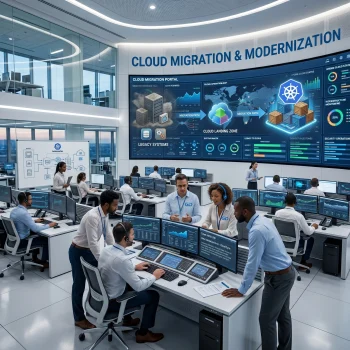
Cloud Migration and Modernisation
Cloud migration is often approached as a one-time technical project, but simply moving workloads into the cloud rarely solves the underlying operational problems. In many cases, organizations end up transferring existing inefficiencies, outdated architectures, security gaps, and scaling limitations into a new environment without improving how systems actually operate. At 3C ITS Cybernara, cloud migration and modernization focus on more than relocation — we focus on transformation. Our approach ensures applications, infrastructure, and workloads are redesigned and optimized to take full advantage of cloud capabilities. This includes improving scalability, performance, resilience, automation, integration, and operational efficiency so the cloud environment delivers measurable business value instead of becoming another layer of complexity.
The Hidden Problems That Follow Organizations Into the Cloud
Cloud migration alone does not solve operational inefficiencies or architectural weaknesses. If existing systems are poorly structured, inefficient, or difficult to manage, those same problems are often transferred directly into the cloud — sometimes becoming even more complex after migration. At 3C ITS Cybernara, we focus on identifying and correcting these issues during modernization instead of simply relocating them.
Legacy Inefficiencies Continue in the Cloud
Applications originally designed for traditional on-premises environments may not operate efficiently in cloud-native infrastructure. Without modernization, these systems often remain expensive to maintain, difficult to scale, and operationally inefficient.
Over-Provisioned Infrastructure Increases Cloud Costs
Systems that were oversized in legacy environments frequently remain oversized after migration. This results in unnecessary cloud spending without delivering meaningful improvements in performance or reliability.
Existing Architectural Problems Become Harder to Manage
Design flaws that were already difficult to maintain on-premises often become more complicated in distributed cloud environments. Instead of simplifying operations, unmanaged migration can increase complexity and operational overhead.
Security Weaknesses Carry Into the New Environment
Weak access management, inconsistent policies, outdated configurations, and poor governance do not disappear during migration. Without structured cloud security design, these same vulnerabilities continue creating operational and security risk.
Hidden System Dependencies Create Migration Challenges
Many applications and services rely on undocumented integrations, shared databases, or interconnected systems. These dependencies can complicate migration timelines and create unexpected failures or operational disruption.
Operational Problems Remain Unchanged
Manual deployment processes, inconsistent monitoring, limited automation, and inefficient operational workflows often continue after migration if they are not intentionally redesigned as part of modernization efforts.
Where Cloud Migration and Modernization Directly Impact Operations
Cloud migration affects far more than infrastructure alone. It changes how applications, data, networking, identity systems, and operational workflows function across the organization. Successful modernization requires every layer of the environment to work together efficiently in the cloud.
Core Business Applications
Applications often require restructuring, optimization, or redesign to perform effectively in cloud environments. Modernization improves scalability, resilience, operational efficiency, and user experience across business-critical systems.
Data Storage and Database Systems
Data must be securely migrated, properly structured, and optimized for cloud-native storage and database services. Poor migration planning in this area can create performance bottlenecks, operational instability, and data management risks.
Networking and Cloud Connectivity
Cloud infrastructure depends heavily on well-designed networking architecture. Connectivity between systems, users, cloud services, and hybrid environments must remain secure, reliable, and scalable as operations evolve.
Identity and Access Management
Authentication, permissions, and identity controls extend across all cloud services and environments. Cloud identity management becomes a central operational and security layer that directly affects governance and access control.
Development, Testing, and Production Environments
Cloud environments require clear separation between development, staging, testing, and production systems. Structured environment management helps reduce deployment risk while supporting safe scaling and operational consistency.
Monitoring, Visibility, and Operations
Operational visibility changes significantly in distributed cloud environments. Monitoring, logging, alerting, and observability must be redesigned to provide accurate insight into performance, security, and system behavior across cloud services.
How 3C ITS Cybernara Transforms Your Cloud Journey
Successful cloud transformation requires far more than simply relocating workloads from one environment to another. At 3C ITS Cybernara, we focus on building cloud environments that improve operational efficiency, scalability, performance, and long-term manageability. Our approach combines migration, modernization, governance, and optimization into a structured transformation strategy.
Comprehensive Assessment Before Migration
We begin by evaluating existing systems, dependencies, workloads, operational risks, and infrastructure requirements. This ensures migration decisions are based on a clear understanding of how your environment actually functions rather than assumptions or generic templates.
Tailored Migration Strategies for Different Workloads
Not every application or system benefits from the same migration approach. Some workloads are best suited for rehosting, while others require refactoring, redesign, or modernization to achieve better long-term operational outcomes.
Modernization Integrated Into the Migration Process
Migration is treated as an opportunity to improve architecture, remove inefficiencies, optimize performance, and modernize outdated systems. Instead of simply moving workloads, we help evolve them into more scalable and manageable cloud-native environments.
Structured Execution With Minimal Operational Disruption
Cloud migration is executed in carefully planned phases with controlled transitions and rollback considerations where necessary. Critical systems receive additional planning and validation to reduce downtime and maintain business continuity.
Security and Compliance Built Into the Environment
Identity management, access controls, security policies, logging, and governance are integrated into the cloud environment from the beginning. Security is designed into the architecture rather than added after deployment.
Why Generic Cloud Migration Strategies Often Fail
Generic migration plans rarely consider how systems are actually used across teams and business operations. As a result, cloud environments become technically functional but operationally misaligned with real-world usage patterns.
Short-Term Speed Creates Long-Term Complexity
Rapid migrations may appear efficient initially, but environments built without proper planning often become difficult and expensive to manage later. Technical debt created during migration increases long-term operational burden.
Opportunities for Modernization Are Missed
Many migrations simply replicate existing infrastructure in the cloud without improving architecture, automation, scalability, or operational processes. This limits the actual value organizations receive from cloud adoption.
Limited Assessment Leads to Unexpected Problems
Without detailed visibility into dependencies, integrations, and operational workflows, migration risks often remain hidden until systems are already being transitioned. This creates avoidable delays, outages, and operational instability.
No Long-Term Operational Roadmap Exists
Once workloads are migrated, many providers consider the project complete. Without ongoing optimization and governance, cloud environments remain static instead of evolving to support future business growth and operational improvements.
Why Choose 3C ITS
Experienced Technical Team
SLA-Driven Support
Remote + Onsite Support
Proactive Monitoring
Multi-Vendor Expertise
Scalable IT Operations
Empower Your Workforce with Reliable IT Support
At 3C ITS, we believe technology support should be proactive, responsive, and business-focused. Our End-User Support & Helpdesk Services help organizations improve employee productivity, reduce downtime, strengthen IT operations, and maintain secure digital workplaces.
Whether you require a centralized helpdesk, onsite IT engineers, endpoint management, or enterprise-wide support services, 3C ITS delivers dependable IT support solutions tailored to your business needs.