Containers and Kubernetes Support
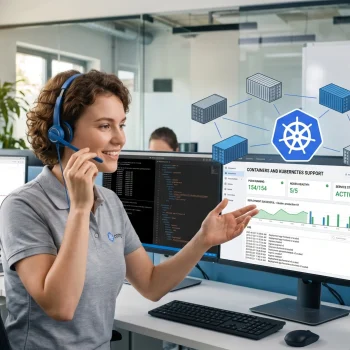
Containers make application deployment faster and more flexible, while Kubernetes provides the orchestration needed to scale modern workloads efficiently. However, as environments grow, container platforms often become increasingly complex, difficult to manage, and challenging to troubleshoot. Without proper structure, organizations end up dealing with unstable deployments, inconsistent configurations, operational sprawl, and visibility gaps that make day-to-day management difficult.
When Container Environments Become Difficult to Control
Container platforms are easy to adopt initially, but as applications, microservices, clusters, and environments expand, operational complexity grows rapidly. Without proper governance and structure, containerized environments become difficult to manage, troubleshoot, and scale effectively. At 3C ITS Cybernara, we focus on bringing stability, visibility, and operational consistency to Kubernetes and container ecosystems.
Growing Services Reduce Operational Visibility
As microservices increase across environments, teams often lose visibility into what workloads are running, how services interact, and where dependencies exist. This makes troubleshooting, scaling, and operational oversight significantly more difficult.
Configuration Drift Creates Inconsistency
Clusters and environments are frequently configured differently over time as teams make independent changes. These inconsistencies introduce deployment instability, troubleshooting challenges, and unpredictable application behavior.
Manual Changes Increase Operational Risk
Teams often rely on manual interventions, emergency fixes, and ad-hoc configuration changes to keep workloads running. Over time, this creates unstable environments that become difficult to maintain reliably.
Scaling Becomes Unpredictable
Without properly configured orchestration and resource management, applications may fail to scale efficiently during periods of increased demand. This results in performance degradation, instability, and inconsistent service availability.
Monitoring and Logging Become Fragmented
Logs, metrics, alerts, and monitoring data are often distributed across multiple clusters and disconnected tools. This fragmentation slows incident investigation and reduces operational visibility during failures.
Platform Ownership Becomes Unclear
Responsibility for container platforms is frequently divided across infrastructure, DevOps, development, and operations teams. Without clear ownership, operational issues remain unresolved longer and accountability becomes inconsistent.
Where Containers and Kubernetes Power Business Applications
Containers and Kubernetes are not isolated technologies — they form the operational foundation for many modern application environments. They directly affect how applications are developed, deployed, scaled, and maintained across cloud and hybrid infrastructures.
Application Deployment and Delivery Pipelines
Containers package applications consistently across development, testing, staging, and production environments. Kubernetes ensures those applications can be deployed repeatedly and reliably through automated orchestration workflows.
Microservices-Based Architectures
Modern applications are increasingly built as distributed microservices instead of monolithic systems. Kubernetes manages communication, scaling, availability, and orchestration across these interconnected services.
Cloud and Hybrid Infrastructure Environments
Containerized workloads frequently operate across public cloud, private cloud, and on-premises environments simultaneously. Kubernetes provides a consistent operational layer that helps unify management across distributed infrastructure.
Development and Testing Environments
Developers use containers to create environments that closely match production systems. This reduces inconsistencies between environments and improves reliability during testing and deployment cycles.
APIs and Backend Application Services
Backend services and APIs rely heavily on container orchestration to maintain scalability, fault tolerance, and service availability. Kubernetes helps ensure these services remain operational under varying workloads.
Batch Processing and Scheduled Workloads
Background tasks, scheduled jobs, and data processing workloads frequently run inside containers. Kubernetes manages workload scheduling, retries, execution timing, and resource allocation to maintain operational efficiency.
How 3C ITS Cybernara Simplifies and Secures Container Environments
A reliable container platform depends on structure, visibility, automation, and operational consistency. At 3C ITS Cybernara, we focus on simplifying Kubernetes and container management while maintaining the flexibility and scalability modern applications require. Our goal is to create environments that remain stable, secure, and manageable as workloads continue to grow.
Structured Cluster Architecture and Standardization
We design Kubernetes clusters using structured architectures, operational standards, and proven best practices. Standardization reduces unnecessary complexity, improves reliability, and simplifies long-term platform management.
Centralized Monitoring and Logging
Visibility across clusters, workloads, nodes, and services is centralized into unified monitoring and logging systems. This allows issues to be identified earlier and investigated more efficiently across distributed environments.
Secure Configuration and Access Management
Role-based access controls, network segmentation policies, workload security settings, and governance standards are applied consistently across the environment. Security controls are enforced without disrupting operational workflows.
Automated Deployments and Intelligent Scaling
Application deployments, workload scheduling, and scaling activities are automated based on resource demand and operational requirements. Automation reduces manual intervention while improving efficiency and deployment consistency.
Resource Optimization and Cost Management
We continuously evaluate resource utilization to ensure workloads consume appropriate compute, memory, and storage resources. This improves performance while preventing unnecessary infrastructure costs.
Why 3C ITS Cybernara Treats Kubernetes as More Than a Deployment Tool
Kubernetes is often viewed only as a deployment platform, but in reality, it functions as a core operational layer that directly affects scalability, reliability, governance, and application stability. At 3C ITS Cybernara, we approach Kubernetes as a continuously managed platform rather than a one-time deployment solution.
Focus on Platform Stability, Not Just Workload Deployment
We treat Kubernetes as the operational foundation supporting applications and services. Before introducing additional workloads, we focus on ensuring the platform itself remains stable, observable, and properly governed.
Designed for Long-Term Operational Management
Container environments must remain manageable as applications, services, and infrastructure evolve. We build Kubernetes platforms that support sustainable operations rather than short-term deployment goals alone.
Architecture Aligned With Real Application Behavior
Cluster architecture, resource allocation, networking, and orchestration decisions are based on how applications actually behave under real workloads and operational conditions — not generic assumptions.
Security and Governance Integrated Into the Platform
Security policies, access management, workload controls, governance standards, and compliance requirements are built directly into the Kubernetes architecture from the beginning instead of being added later as reactive fixes.
Scalable Growth With Operational Control
We ensure scaling happens in a controlled and predictable manner. As workloads expand, the platform remains stable, manageable, and operationally consistent without introducing unnecessary instability.
Continuous Optimization and Improvement
Kubernetes environments require ongoing refinement as technologies, workloads, and operational requirements evolve. We continuously improve configurations, performance, monitoring, and operational processes to maintain long-term platform health and reliability.
Why Choose 3C ITS
Experienced Technical Team
SLA-Driven Support
Remote + Onsite Support
Proactive Monitoring
Multi-Vendor Expertise
Scalable IT Operations
Empower Your Workforce with Reliable IT Support
At 3C ITS, we believe technology support should be proactive, responsive, and business-focused. Our End-User Support & Helpdesk Services help organizations improve employee productivity, reduce downtime, strengthen IT operations, and maintain secure digital workplaces.
Whether you require a centralized helpdesk, onsite IT engineers, endpoint management, or enterprise-wide support services, 3C ITS delivers dependable IT support solutions tailored to your business needs.